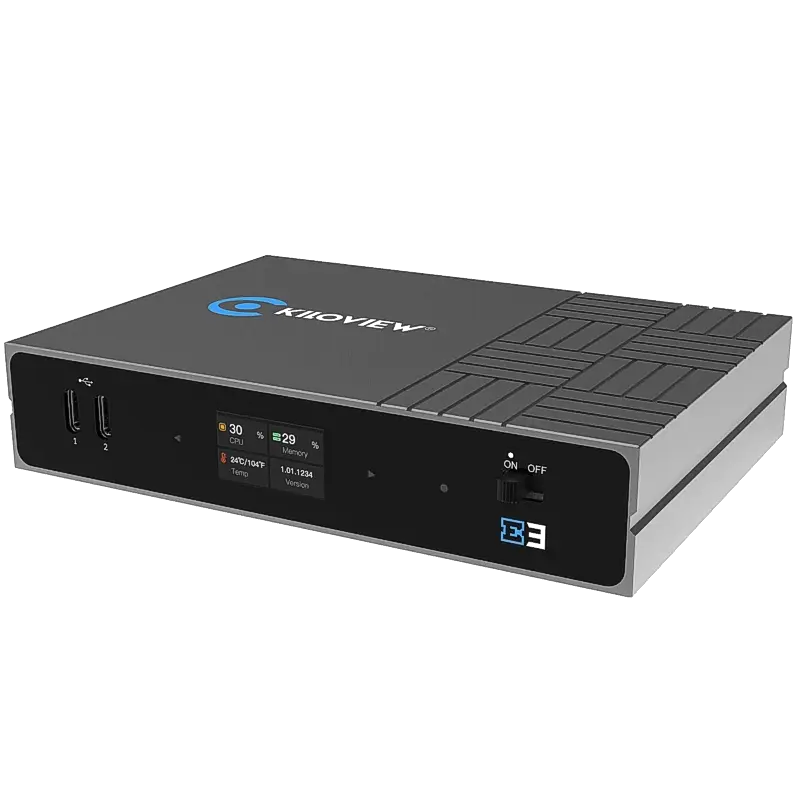
Kiloview E3 Dual-Channel 4K Encoder
Two independent 4K encoding channels in one unit — each with HDMI 2.0 and SDI input, each streaming independently to NDI, SRT and RTMP simultaneously.
- Two completely independent 4K encoding channels — two cameras, two separate NDI sources, two separate stream destinations, all from one unit
- Each channel has its own HDMI 2.0 input at 4K60 and 3G-SDI input at 1080p60 — handle mixed signal formats across the two channels without adapters
- H.265 hardware encoding per channel — two cameras at broadcast quality simultaneously with the bandwidth efficiency of HEVC
- Each channel outputs NDI|HX2 as a separate, independently named NDI source on the local network — both sources visible in vMix and OBS simultaneously
- Simultaneous SRT and RTMP per channel — each camera can stream to a different YouTube channel or SRT destination independently
- Half the rack space and power of two individual encoders — significant efficiency for multi-camera permanent installations
What is the Kiloview E3?
The Kiloview E3 is a dual-channel 4K hardware encoder — one physical unit containing two completely independent encoding engines. Where a single-channel encoder processes one camera, the E3 processes two simultaneously, with each channel operating entirely independently: its own inputs, settings and output destinations.
For studios deploying multiple cameras, the E3 represents a significant efficiency advantage over two separate single-channel encoders. It occupies half the rack space, uses a single power connection, requires a single network connection, and is managed from one web interface — while delivering identical per-channel performance to individual units.
Complete channel independence
Channel 1 can encode a 4K HDMI camera to NDI|HX2 for the local production network while streaming via SRT to a remote facility. Channel 2 can simultaneously encode a 3G-SDI camera at a different bitrate and stream to YouTube via RTMP. Neither channel has any awareness of or dependency on the other.
Input flexibility per channel
Each channel includes both HDMI 2.0 (4K cameras and AV sources) and 3G-SDI (broadcast cameras and legacy SDI). The E3 can handle a mixed-format production — a 4K HDMI PTZ camera on Channel 1 and a 3G-SDI broadcast camera on Channel 2 — without additional hardware.
Deployment scenarios
The E3 suits lecture theatres with two cameras, dual-camera sports venues, broadcast facilities with camera pairs at a single position, and corporate studios needing encoder redundancy within one physical unit. Contact us for specific multi-camera deployment requirements.
| Video Inputs (per channel — 2 channels) | |
| HDMI Input (per ch.) | 1x HDMI 2.0 Type A — up to 3840x2160 at 60fps |
| SDI Input (per ch.) | 1x BNC 3G-SDI — up to 1920x1080 at 60fps |
| Total Inputs | 2x HDMI 2.0 plus 2x 3G-SDI (4 physical inputs) |
| Encoding (per channel) | |
| Video Codec | H.265 (HEVC) and H.264 (AVC) — hardware per channel |
| Max Resolution | 3840x2160 at 60fps per channel (HDMI) |
| Max Bitrate | Up to 100 Mbps per channel |
| Audio | AAC — embedded HDMI/SDI audio per channel |
| Output Protocols (per channel, independent) | |
| NDI | NDI|HX2 — each channel a separate NDI source on the LAN |
| SRT | SRT Caller / Listener / Rendezvous with AES encryption |
| RTMP / RTMPS | RTMP and RTMPS to any platform per channel |
| HLS / RTSP | HLS and RTSP server per channel |
| Network | |
| Ethernet | 2x Gigabit Ethernet (RJ-45) |
| Wi-Fi | IEEE 802.11a/b/g/n/ac |
| Management | Web-based UI — separate configuration per channel |
| Physical | |
| Form Factor | Desktop / rackmount (rack ears optional) |
| Power | DC 12V (included) |
| Cooling | Active fan |
| Operating Temperature | 0C to 45C |
| Certifications | CE, FCC, RoHS |
| Product Information | |
| SKU / Model | KV-E3 |
| Warranty | 2 years — Kiloview |
| Availability | Contact us for current lead time and pricing |
Specifications sourced from Kiloview product documentation and correct at time of publication. Subject to change — contact us to confirm before specification.
The E3 is designed for deployments where two cameras need simultaneous encoding — offering the efficiency of one unit while maintaining complete independence between channels.
Dual-Camera Lecture Theatres
Encode a fixed wide-angle camera on Channel 1 and a close-up presenter camera on Channel 2 simultaneously. Each delivers an independent NDI source to Panopto or Kaltura for true multi-camera lecture recording from one encoder.
Houses of Worship
Channel 1 handles the stage camera while Channel 2 handles a wide congregation shot. Both stream to YouTube Live via RTMP simultaneously, or one feeds the local NDI production system while the other streams externally — fully independent per channel.
Sports and Venues
Camera pairs covering different angles — pitch-side and elevated — each encoded independently to NDI for the on-site production system and simultaneously to SRT for remote production. Two cameras, one encoder, one network connection.
Broadcast Facilities
Two independent encoding channels per rack position — the E3 doubles camera capacity per rack unit compared to single-channel encoders, with optional rack mounting ears for standard 19-inch installation.
Corporate Studios
Main presenter camera on Channel 1 (4K HDMI) and secondary wide-room camera on Channel 2 (SDI) both encoded and distributed to the NDI production network. Mixed HDMI and SDI inputs on the same unit.
Medical Training
Dual cameras — procedure camera on Channel 1 and overhead room camera on Channel 2 — simultaneously encoded for a recording system and remote observation point with independent bitrate settings per clinical purpose.
Are the two channels truly independent?
Yes — completely. Each has its own input selection, encoding settings, NDI source name and streaming destinations. Changing Channel 1 settings has no effect on Channel 2. They can encode at different resolutions and stream to entirely different destinations simultaneously.
Can the E3 output two separate NDI streams at the same time?
Yes. Each channel appears as a separately named NDI source on the local network. In vMix or OBS you would see two Kiloview E3 NDI sources — one per channel — which can be assigned to any input independently.
Can the two channels use different output protocols?
Yes. Channel 1 could output NDI|HX2 and RTMP to YouTube. Channel 2 could simultaneously output NDI|HX2 and SRT to a remote facility. There is no requirement for both channels to use the same configuration.
Does the E3 accept SDI and HDMI on the same channel simultaneously?
Each channel accepts either HDMI 2.0 or 3G-SDI — you select the active input per channel in the web interface. Channel 1 can use HDMI while Channel 2 uses SDI, giving mixed-format encoding from one unit. The two inputs on a single channel cannot be active simultaneously.
Is the E3 rack mountable?
The E3 is supplied in desktop form factor. Rack mounting ears are available as an optional accessory for standard 19-inch rack installation. Contact us for accessory availability.
Both channels of the E3 appear as separate NDI sources in production software, and each channel streams to its own independently configured SRT or RTMP destination.
NDI Production SoftwareThe Kiloview E3 Dual-Channel 4K Encoder appears as an NDI source automatically on the local network via mDNS discovery. No manual IP configuration required on the same subnet.
Streaming Platforms and Software (SRT / RTMP)Import recorded files (MP4/MKV) directly into any NLE for post-production editing.
Contact us to confirm compatibility with a specific software version or platform not listed above.